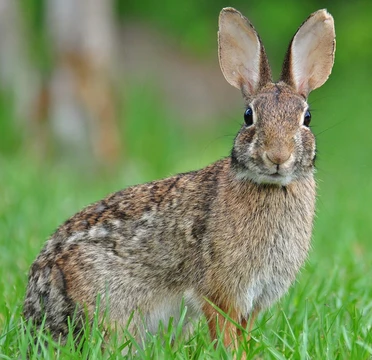
Cottontail rabbit
Small lagomorphs of the Americas with white-tailed retreat signals.

Cottontail rabbits are the species within the genus Sylvilagus, part of the family Leporidae. Found throughout the Americas, they are named for their characteristic stub tails with white undersides, though this feature is not universal to all species nor unique to the genus. Their fur ranges from brown to gray and changes seasonally.
- genus
- Sylvilagus
- family
- Leporidae
- distribution
- North America, Central America, northern and central South America
- average_lifespan
- about two years
- average_litter_size
- four (range two to eight)
- reproduction_age
- females can begin reproducing at six months old
- closest_relative
- Brachylagus (pygmy rabbit)
Lore & Background
Cottontail rabbits live in nests called forms and have altricial young. They often inhabit edges of fields, farms, and open spaces away from dense human populations, though they sometimes nest in yards and parks. An adult female averages three litters per year, which can occur in any season; litter size depends on time of year, weather, and location. Most offspring do not survive to adulthood. Cottontails show greater resistance to myxomatosis than European rabbits. Their behavior differs from rodents: they eat while on all fours, using their noses to adjust food on the ground, and only use front paws to bend branches for vegetation above head height. They rarely forage on windy days, as wind interferes with hearing, their primary defense against predators. Predators include domestic dogs, cats, humans, snakes, coyotes, mountain lions, foxes, and birds of prey; even squirrels may attack if the rabbit shows signs of illness. They are also parasitized by botfly species such as Cuterebra fontinella.
Reader's Guide
Cottontail rabbits, as the genus Sylvilagus, represent a widespread and adaptable group of lagomorphs across the Americas. Their ecological role as prey for numerous predators—from birds of prey to mammals—makes them a key component of many food webs. Their reproductive strategy, with multiple litters per year and early maturation, allows populations to persist despite high mortality. The genus's resistance to myxomatosis, a disease devastating to European rabbits, highlights evolutionary differences within Leporidae. Molecular studies have questioned the traditional subgeneric classifications based on morphology, indicating that phylogenetic relationships within Sylvilagus remain incompletely understood. Prehistoric species such as Sylvilagus hibbardi and Sylvilagus leonensis show the genus's long presence in the fossil record. Their behavior—foraging on all fours and relying on hearing to avoid predation—distinguishes them from rodents and underscores their specialized adaptations to open and edge habitats.
Did You Know?
- The generic name Sylvilagus combines Latin sylva ('woods') and lagus ('hare'), meaning 'hare of the woods'.
- Cottontails use burrows vacated by other animals, and predators can learn to repeatedly return to these burrows.
- Newborn cottontails are particularly vulnerable to botfly parasitism by species such as Cuterebra fontinella.
- Surviving cottontails grow very quickly and are full-grown adults at three months.
More in Rodents And Lagomorphs 1-21
Spotted an error? Know more?
This is a living reference — every entry is fact-audited, and reader corrections feed straight into our audit queue. Suggest an edit · See this site's audit record